
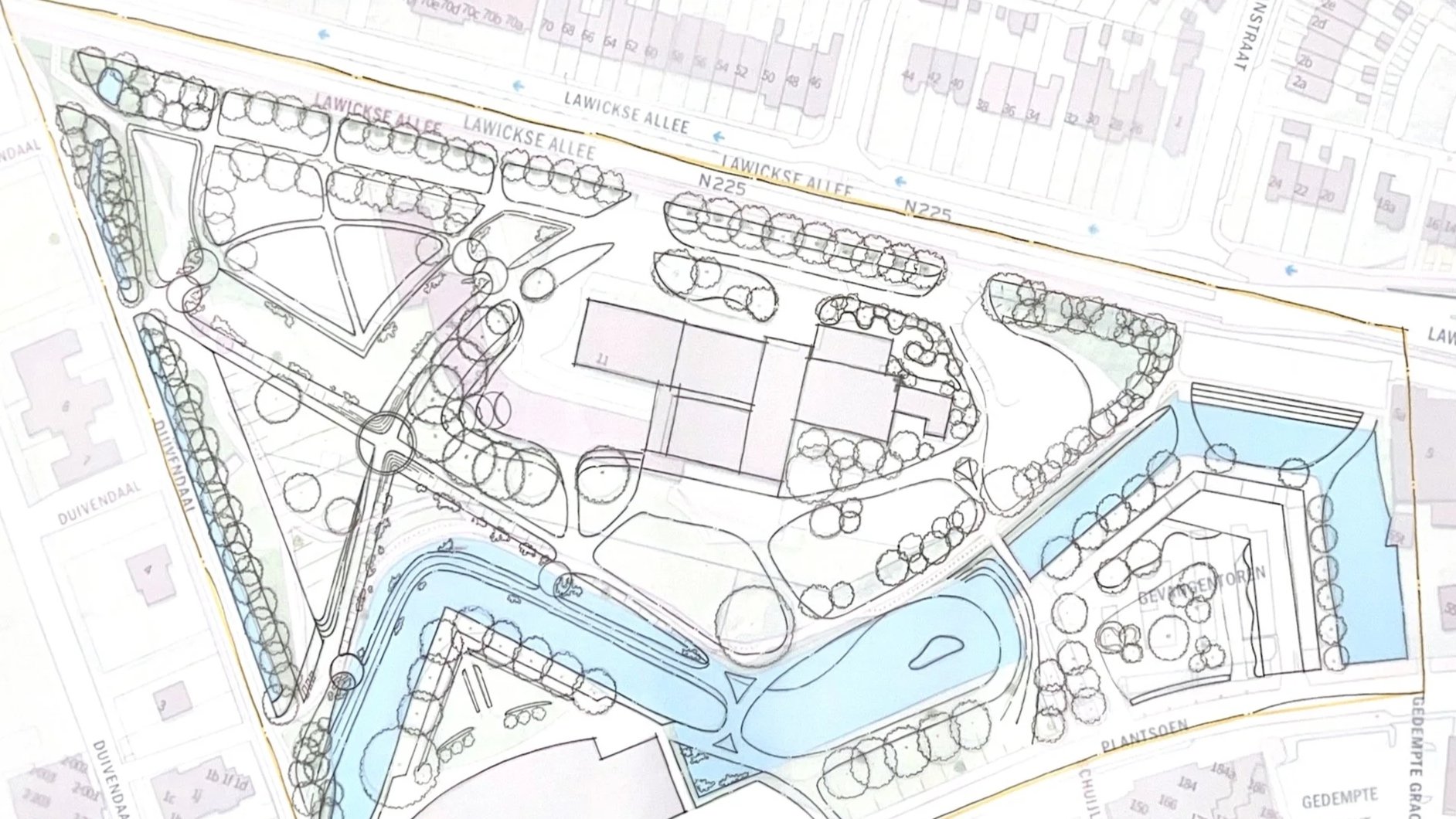
Continuing Knowledge
Course: Studio Site Design
Institution: Wageningen University & Research
Scale: Park section
Date: December 2025
Continuing Knowledge presents a city park in which different historical stories of Wageningen are spatially translated into a walkable and reflective landscape. Designed as part of the course Studio Site Design, the project explores how a deep reading of a specific site can inform an overarching design concept.
Through the use of symbolism, sequencing, and spatial cues, both well-known and lesser-known narratives are embedded in the landscape. This invites visitors to actively decode meaning rather than passively consume it. In this way, abstract ideas and local histories become experiential tools that encourage reflection, awareness, and spatial empowerment.
Design Position
During this design studio, I developed a framework I had already been applying intuitively in earlier work. This framework positions landscape architecture as a critical, reflective, and socially responsive practice. It responds to contemporary societal conditions shaped by complexity, exclusion, and overstimulation. These conditions can add confusion, polarisation, or disengagement.
Spatial empowerment, as I understand it, seeks to counter these conditions by designing environments that invite understanding, cultivate attention, and create space for alternative perspectives. Rather than neutral backdrops, landscapes become active agents that shape how people orient themselves, engage with reality, and relate to one another.
Framework of Spatial Empowerment
Designed for Decoding
Spaces that offer understandable complexity. They invite exploration, orientation, and learning rather than exclusion or confusion.
Reality Shifting
Landscapes that cultivate attention, presence, and collective rejuvenation, countering distraction and constant stimulation.
Radical Re-centering
Design that foregrounds marginalised perspectives and alternative narratives instead of reproducing dominant spatial logics.
DESIGN TRANSLATION
Concept
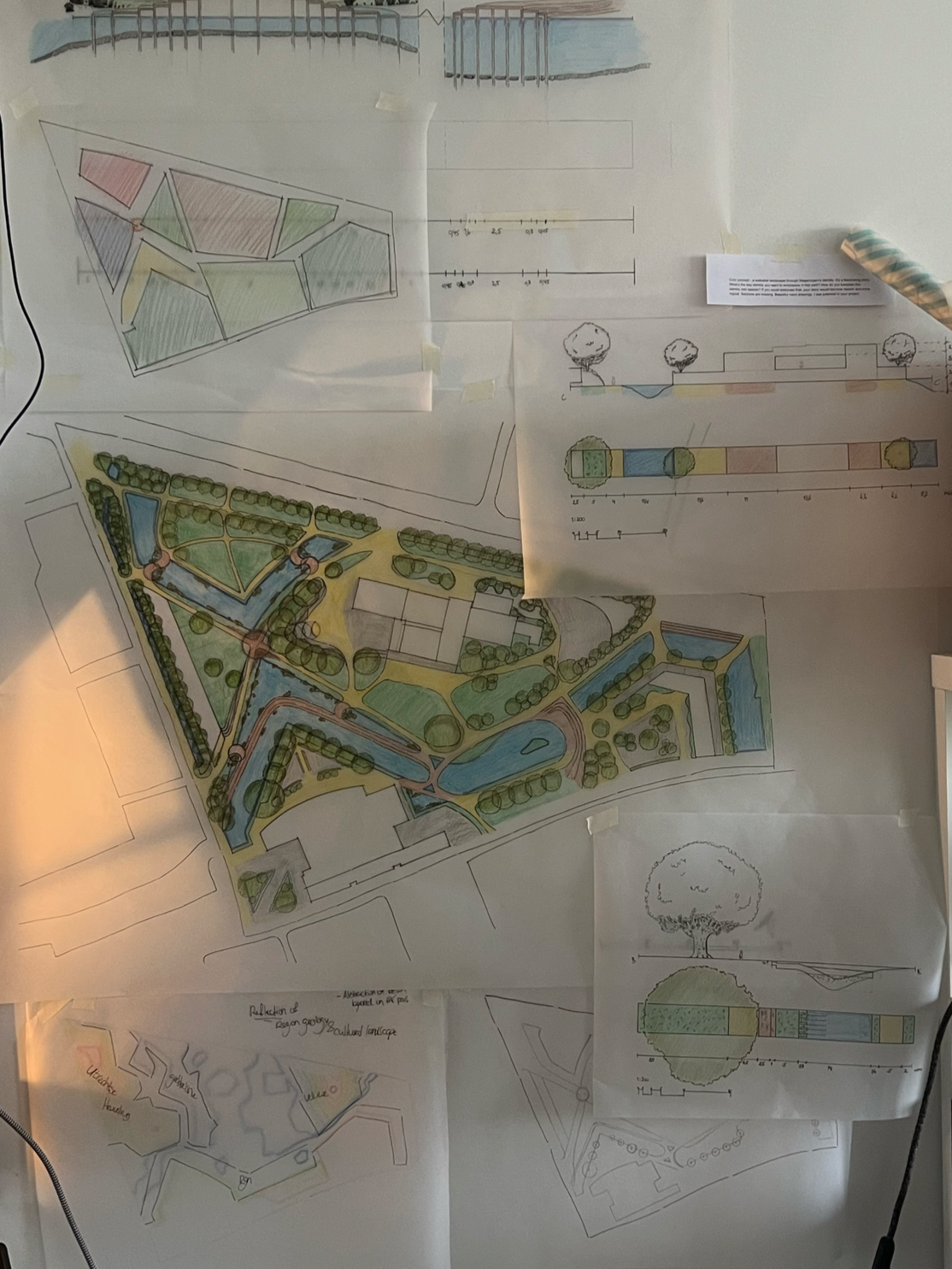
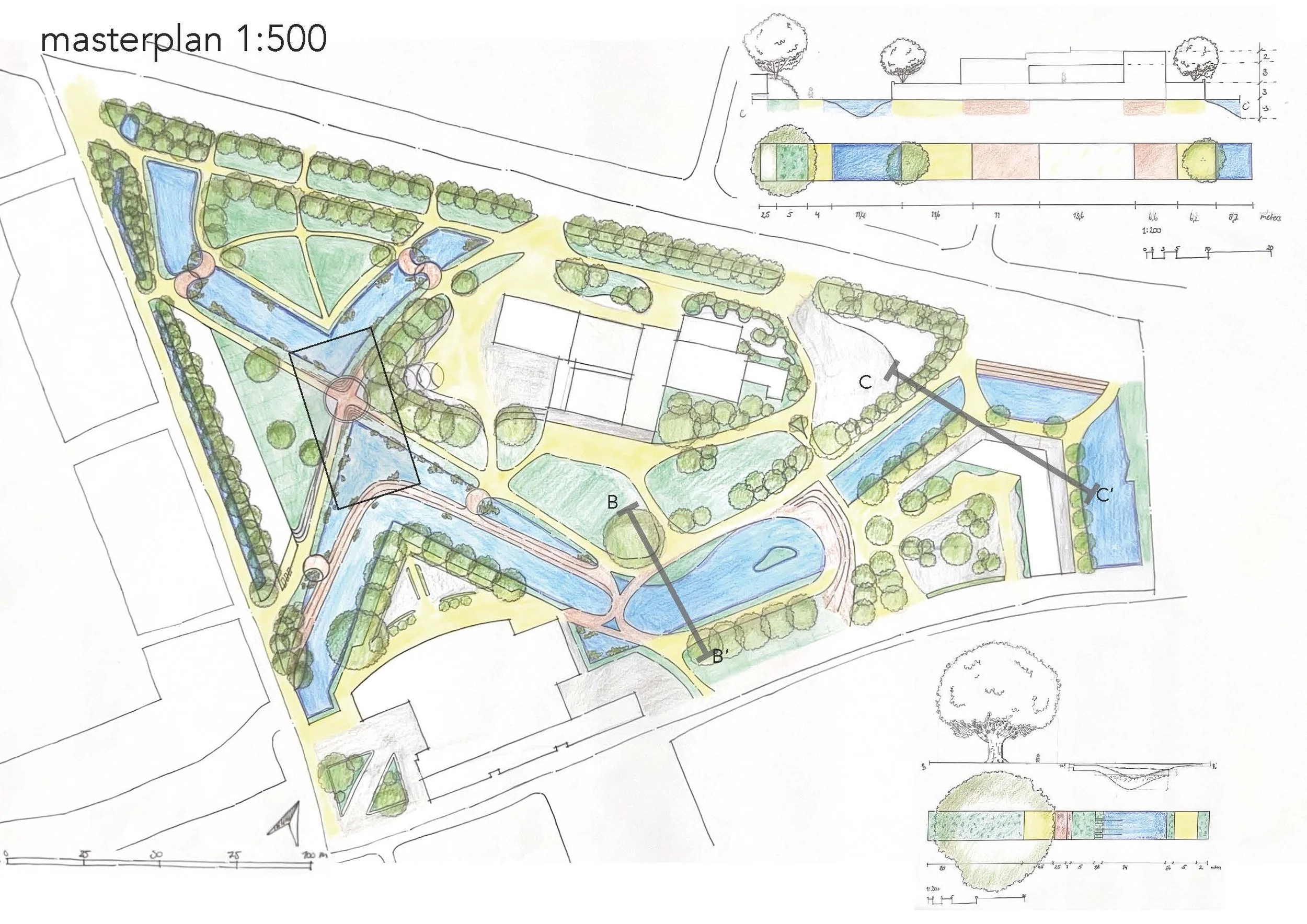
In Junuspark, the three pillars of the Spatial Empowerment framework were applied simultaneously rather than hierarchically. Spatial legibility, moments of pause, ecological processes, and social openness were developed together. This allows the park to function as a place of orientation, attention, and shared presence within the city centre.
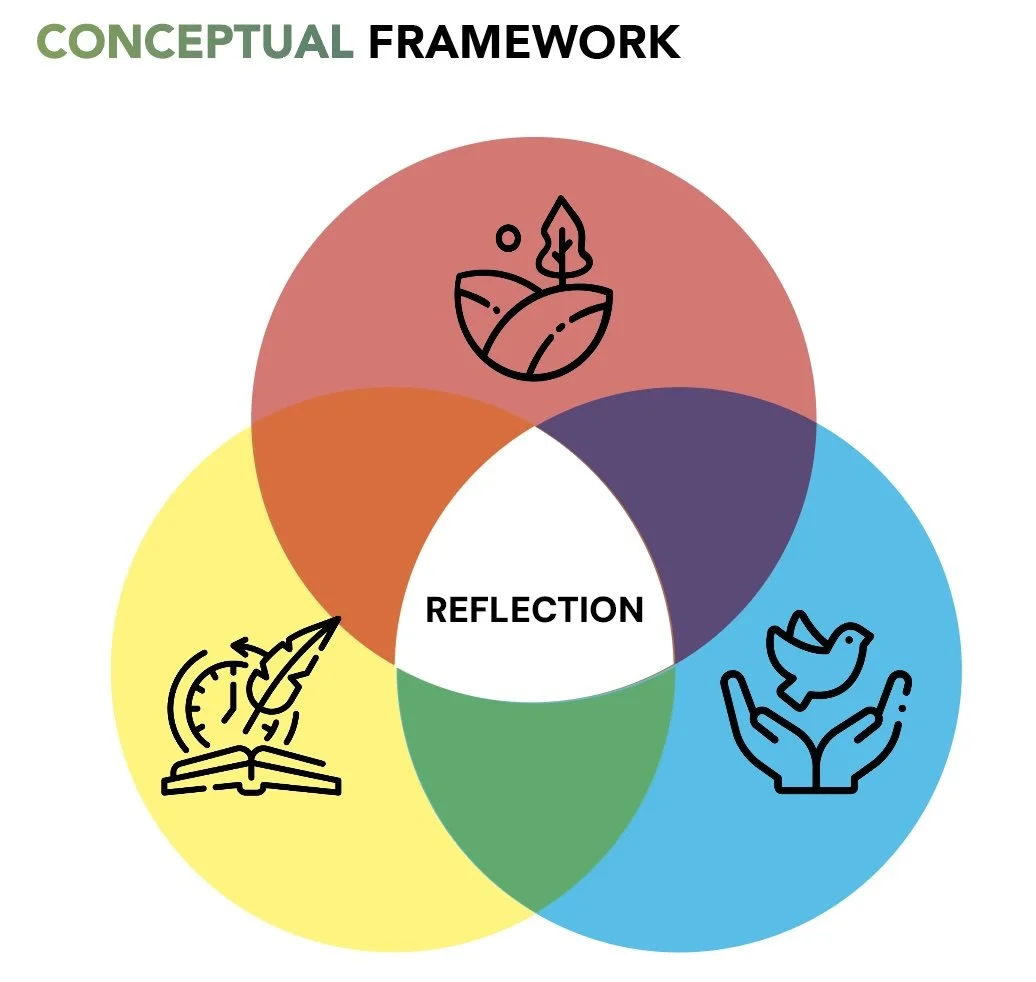
Functioning as such, the design required a unifying concept capable of connecting spatial clarity, social meaning, and historical depth. This became ‘Reflections’. The place calls for identity. Wageningen has layers in landscape, colonial history, science, and international connections.
I noticed that all these layers have something in common: You can see them as reflections of what Wageningen is. It can be translated through landscape, history, paths, water, stories. That is why “Reflection” became my guiding concept. It is a way of connecting both the large scale and the human scale. This will be done by taking inspiration from large scale layers and translating them into the experiential human scale.
Reflection of Cultural Landscape

Reflection of Freedom
Reflection of History and International Connections

DESIGN TRANSLATION
Reflections in the Park
The different layers of Wageningen have been structured in three equal reflections:
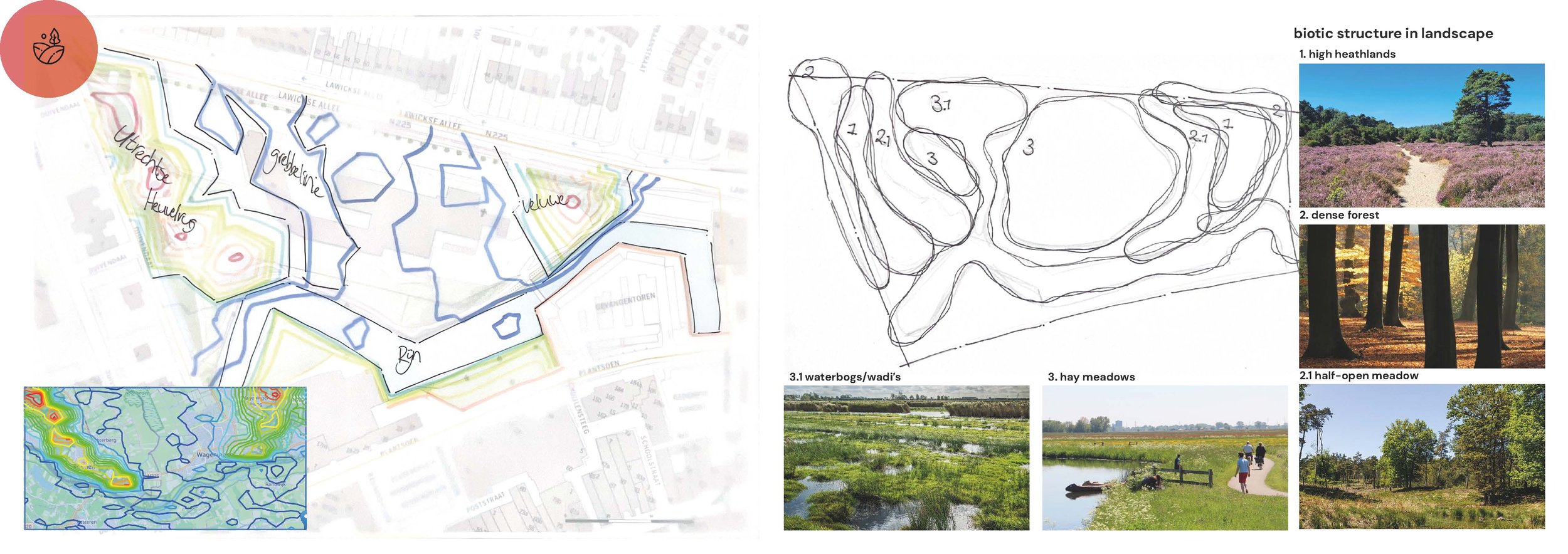
Reflection of Cultural Landscape
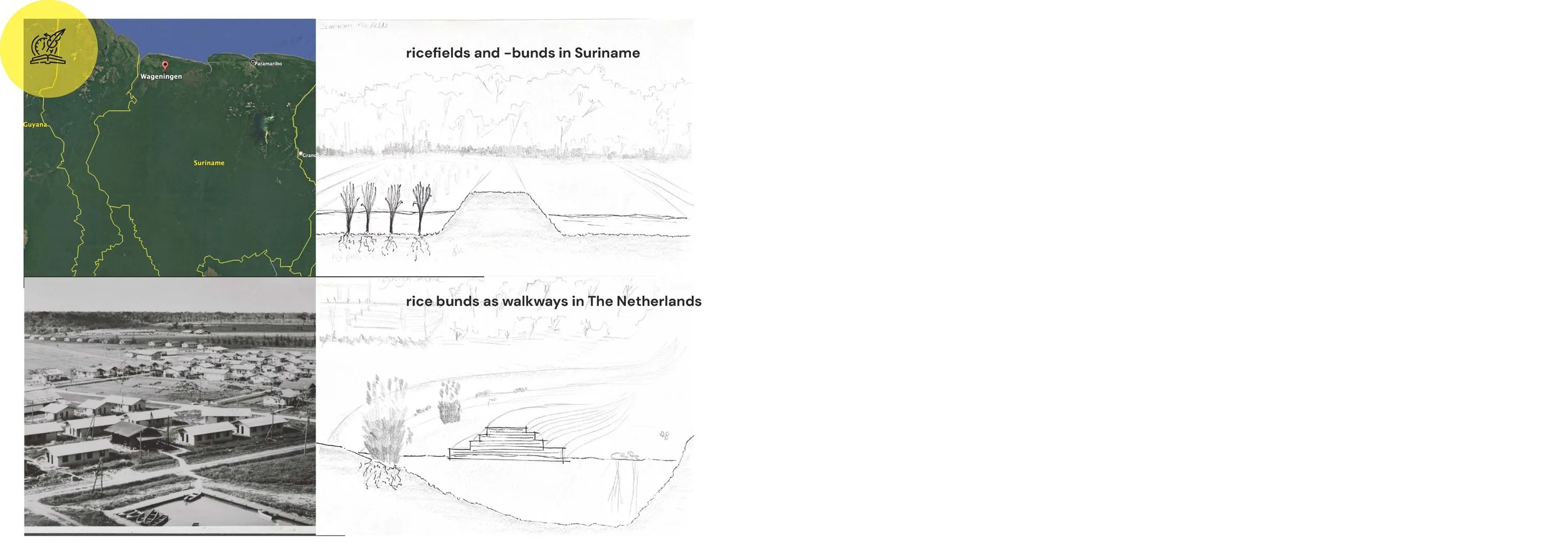
Reflection of History and International Connections
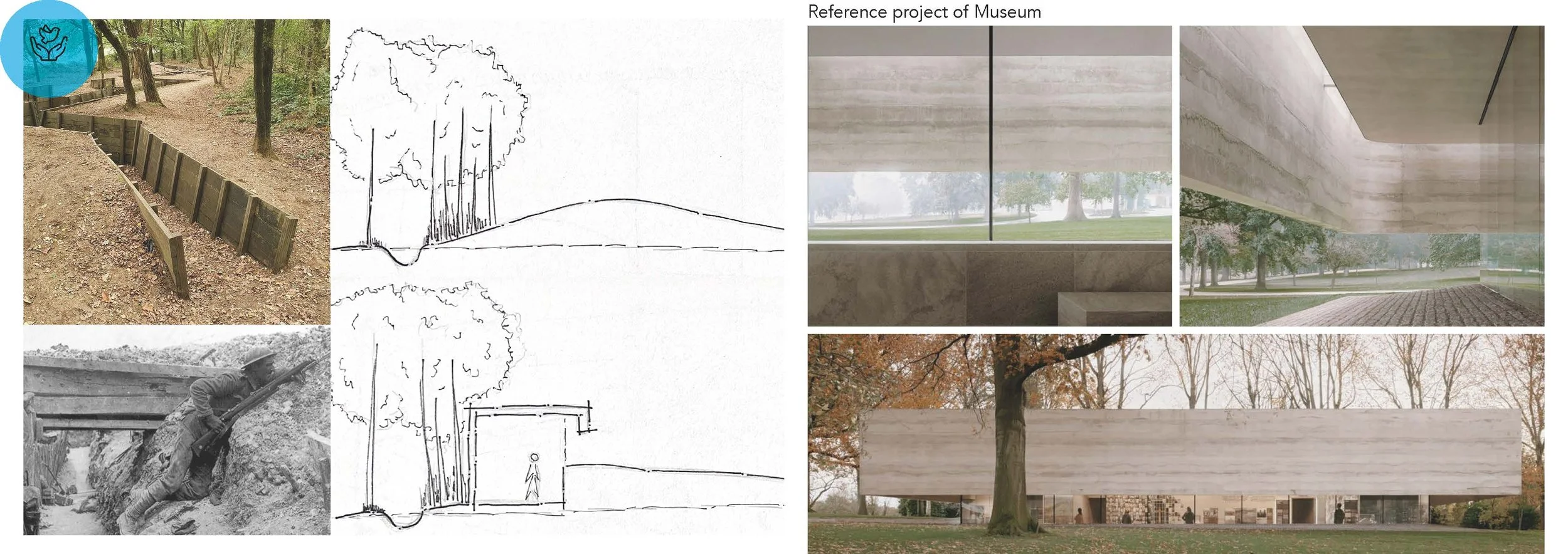
Reflection of Freedom
The cultural landscape determines and explains differences in height, abiotic forms, large spatial gestures. It translates the region, moraine valley, and the Old Rhine into the park.
Wageningen is also known as the city of freedom. To take advantage of the program of incorporating a Museums of Life Sciences, connected to the University, the reflection informed me where the location and cut of the museum will be. 1 meter below ground level, as it is a reference to the trenches used during the Second World War. As without the freedom and sacrifices of our freedom fighters, we would not have the prestige knowledge we can share today. Additionally, it pulls the landscape towards your senses, giving you a framed view over the landscape, adding to the reflective nature of the park.
The history and international connections of Wageningen has a rich colonial history. We can see this history reflected in Suriname, where the port town of Wageningen is named after the Dutch city . It was a colonial project set up in 1950’s by the Dutch agricultural university, or WUR, to investigate how rice could optimally be grown there. Maroons have been producing their rice varieties in a unique way for centuries. They did not follow an agricultural model based on infinite growth or uniform production. Instead, they worked with site-specific agricultural practice in which rice could adapt to the local ecology. The Maroons have been producing a variety of robust agricultural crops within existing ecological limits for generations. This is an important lesson at a time where ecosystems are drastically being depleted.
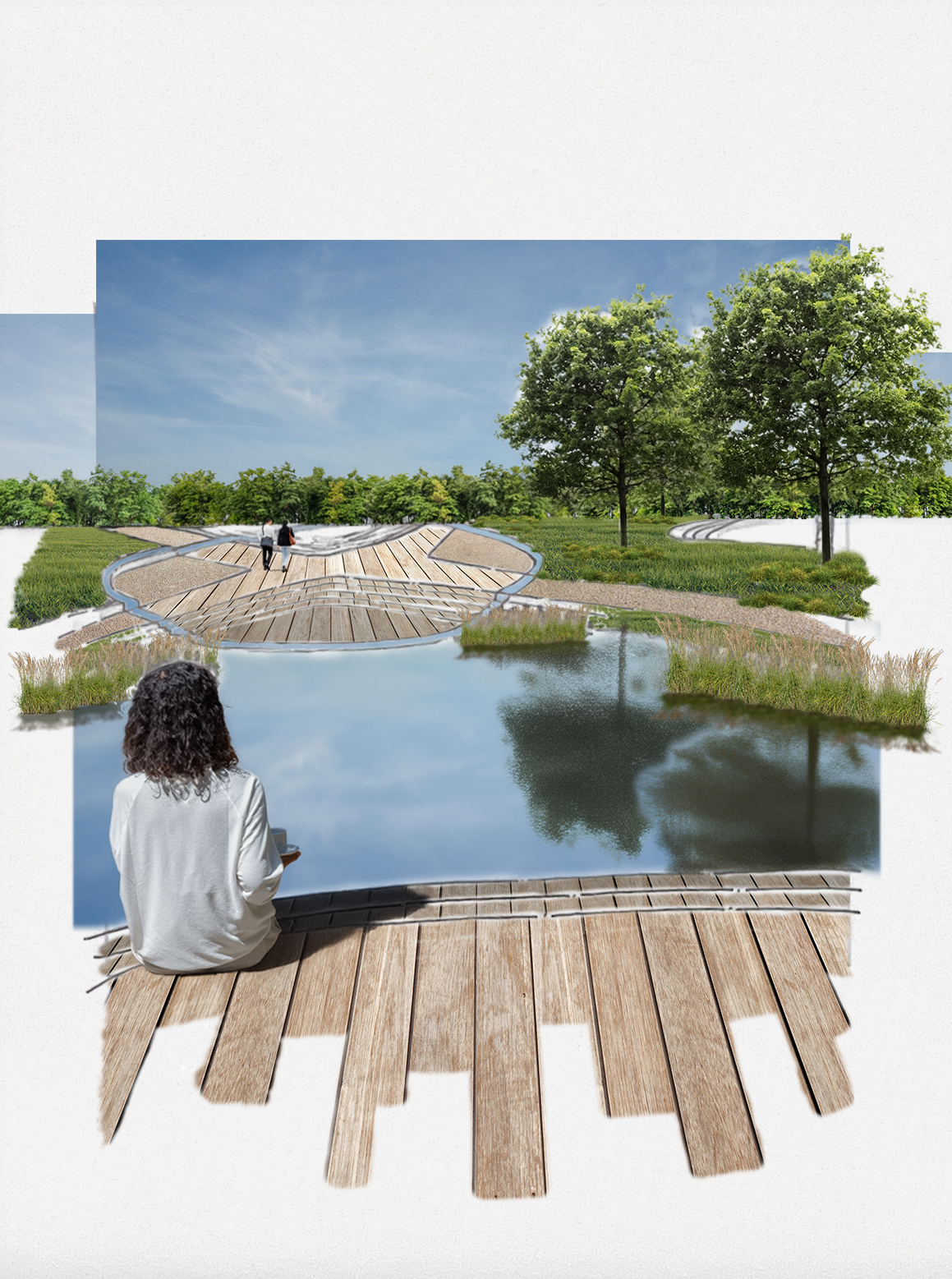
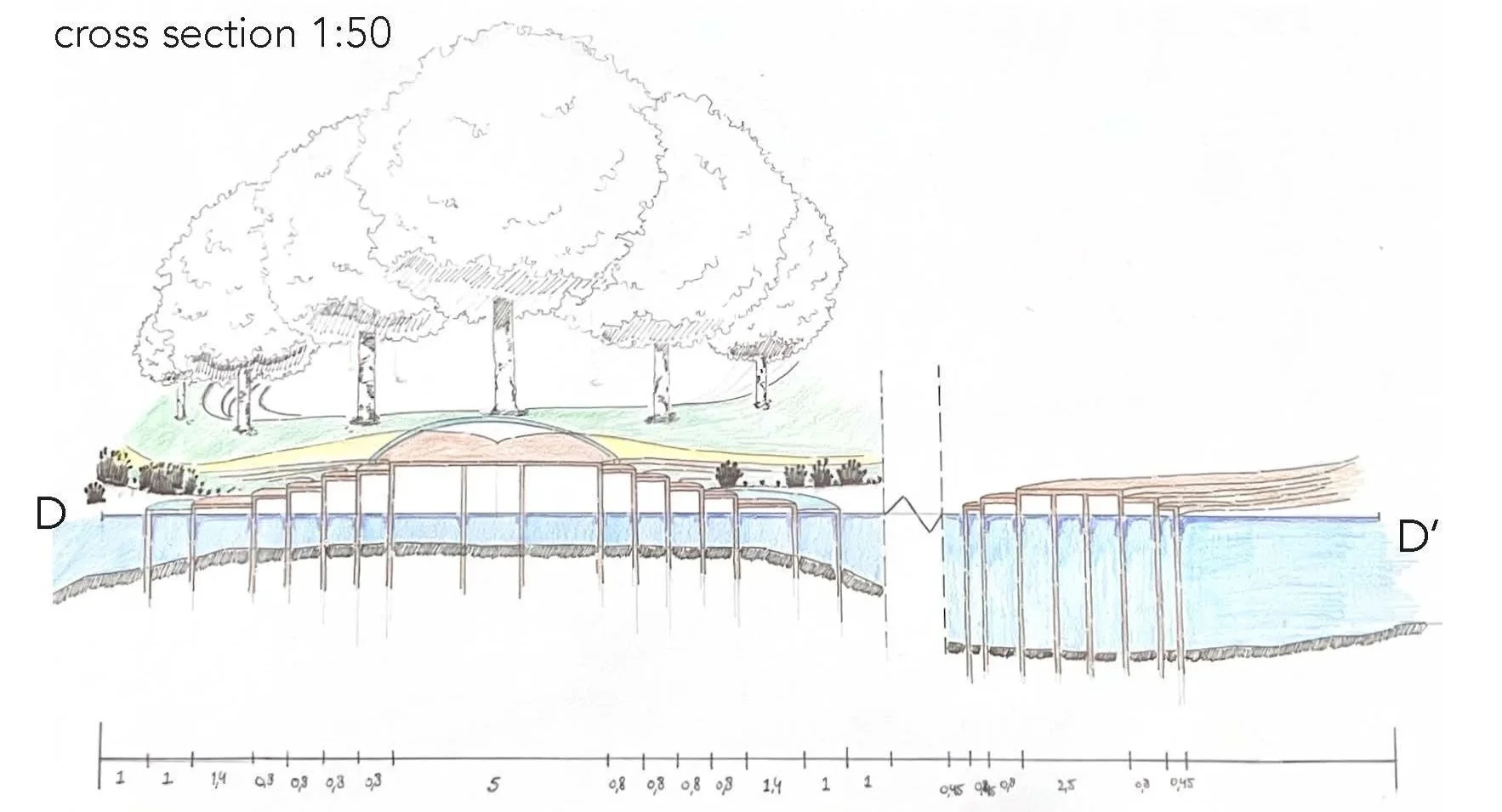
Taking inspiration from the rice fields in Wageningen Suriname, I have used the bunds, or earthen walls, between the rice fields as design inspiration. The tapered structure of the bunds have been used in the wooden deck, where visitors in the park can walk over water, and sit on the structure as it has stairs towards the water.
DETAILED PLAN 1:100
The Eclipse
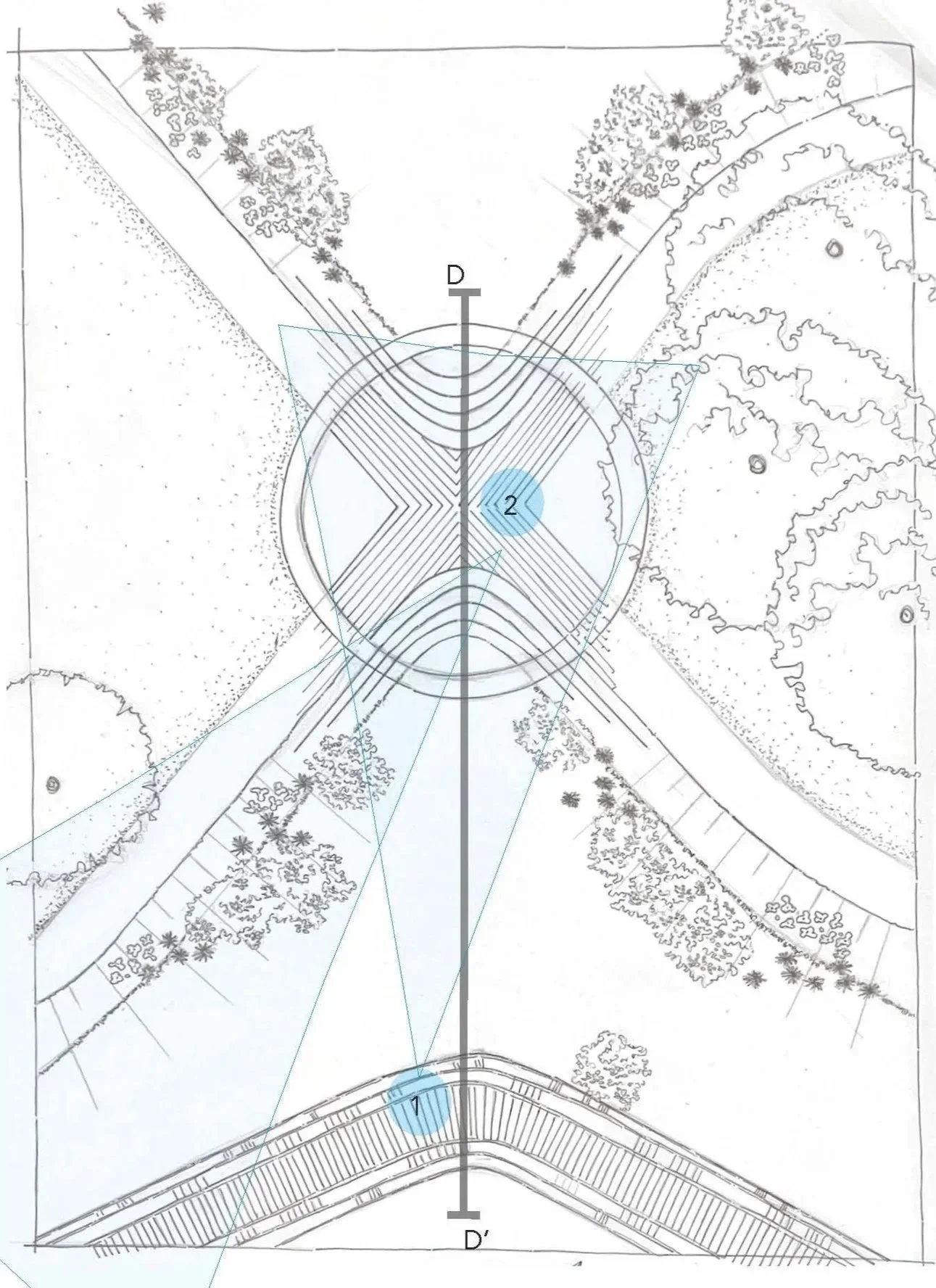
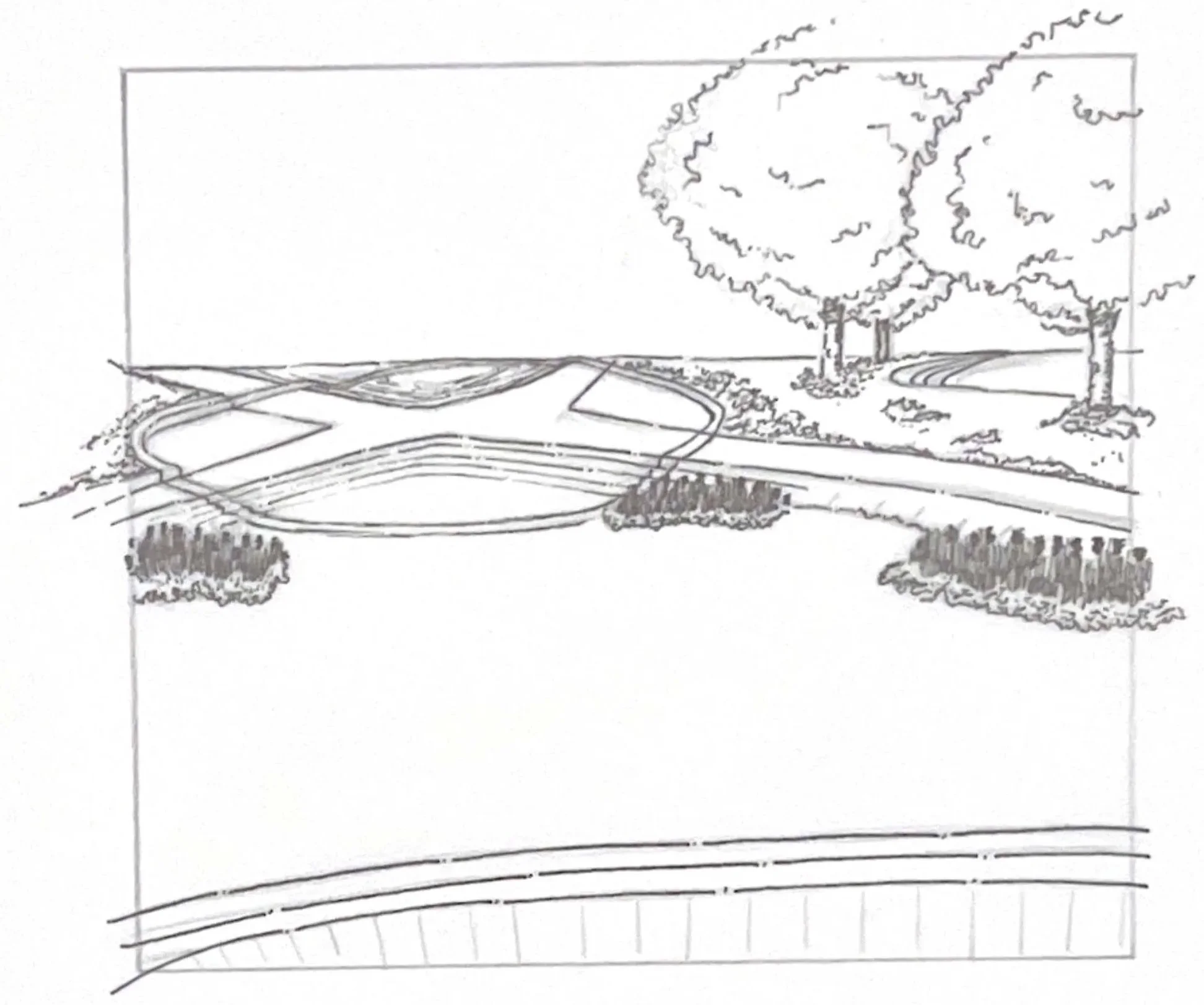
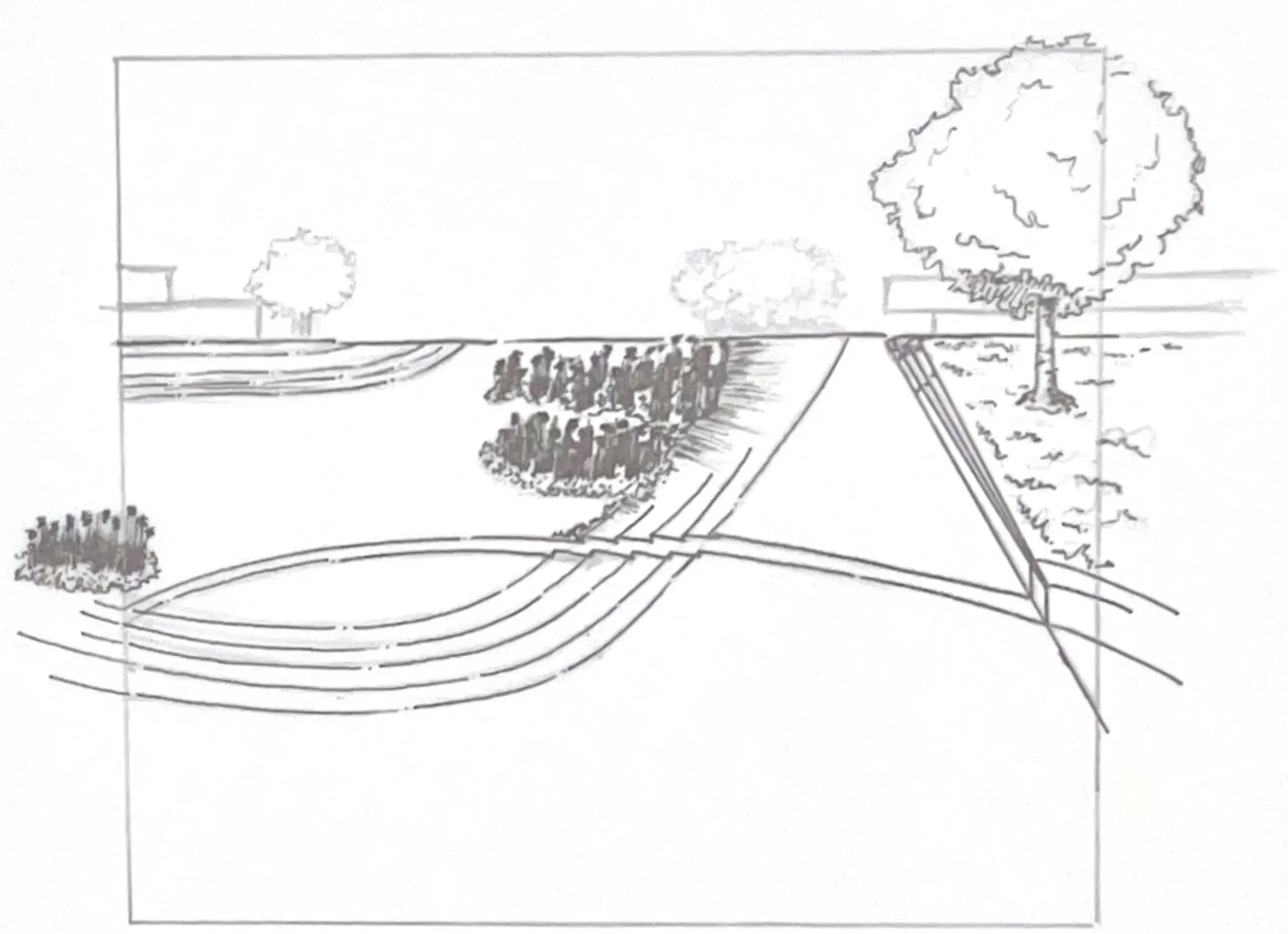
The focal point of the detailed plan is a circular square that symbolises an eclipse. Positioned at the heart of the design, it crosses the water and functions as a place to meet, pause, and reflect. The stairs on the north and south edges descend towards the water, inviting people to sit, linger, and engage with the surrounding landscape at eye level.
The symbolism of the eclipse reflects the overarching theme of Reflections in multiple ways. Within Afrofuturist thought, an eclipse represents a portal or bridge to another reality. Spatially, this idea is translated literally: the square acts as a bridge across the water, while also positioning itself between the layered historical and cultural reflections of Wageningen. In this sense, the space becomes a threshold, both physical and conceptual, between narratives.
Western traditions often associate knowledge with light and enlightenment. In contrast, Afro-diasporic spirituality recognises the shadow as a site of introspection, ancestral presence, healing, and knowledge beyond colonial logic. By drawing on this contrast, the eclipse introduces a moment where light is temporarily suspended, allowing reflection to emerge from stillness rather than exposure.
Across many cosmologies, an eclipse is experienced as a collective moment of reflection: a shared event that interrupts daily routines and draws people into simultaneous observation. This human response, stopping, watching, and becoming aware, informed the spatial design of the square, where movement slows and attention is redirected inward and outward at once.
1
2
Reflection
Applying this framework to Junuspark helped me make an explicit design approach I had previously used intuitively. It made me aware of how spatial decisions can either reinforce or counter broader societal mechanisms. At the same time, I see the spatial empowerment framework not as a fixed methodology, but as an evolving lens. It is open to adaptation, as it can be challenged, or reconfigured depending on context and scale.
FINAL POSTER
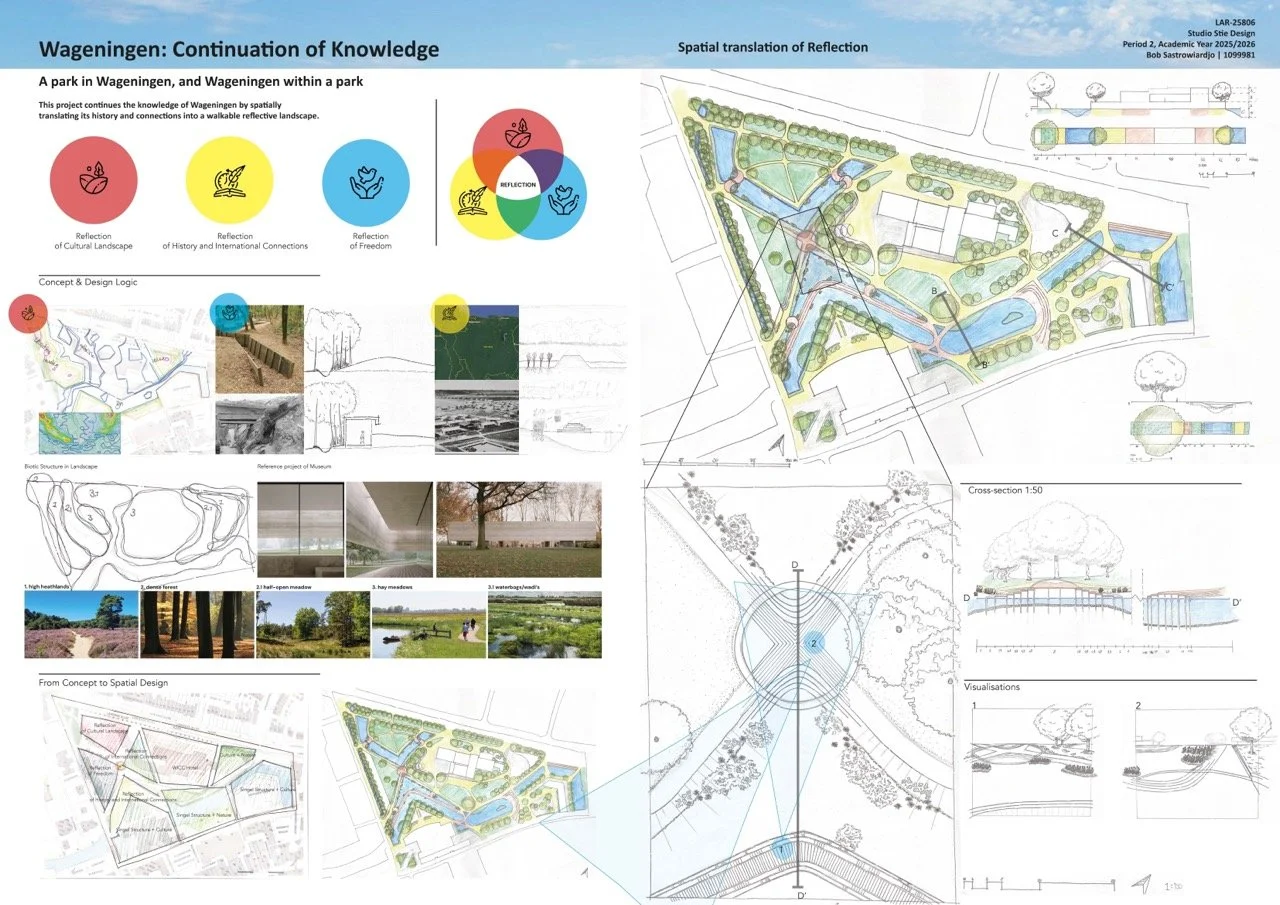
Continuing Knowledge presents a city park in which different historical stories of Wageningen are spatially translated into a walkable and reflective landscape. Designed as part of the course Studio Site Design, the project explores how a deep reading of a specific site can inform an overarching design concept.